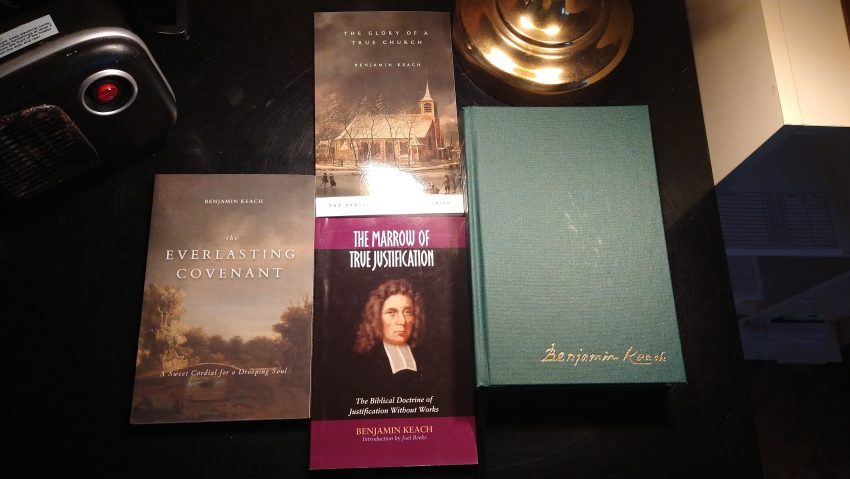
Introduction
| Tonight, I’m going to toast, Benjamin Keach. A man who was born two years before the English Civil War of 1642. A man who lived through that war, who lived under the Lord Protectorate of Olive Crowell, who saw the collapse of that failed republic, who saw the restoration of the monarchy, and who endured religious persecution during the restoration of his country. His time was very different from our time, so I feel obligated to give a short summary of the period in which he lived and the events that lead up to it.
To given my audience a feel for the tensions that led up to the English Civil War, I’ll start by describing the religious laws put in place during the Elizabethan Religious Settlement of 1559. Then I’ll get into some of the political tensions that lead up to the war as well.
Pre-Civil War History and the Reign of King James I
I won’t get into how, or why, the Church of England split from Roman Catholicism, but it happened some time back in the 1530s. As a result, in no Catholic served as monarch for over 130 years. After the split, notably, England had it’s own religious reformation like that seen elsewhere. This culminated in the passing of the aforementioned religious settlement. This settlement established the Church of England as the state church which was under the royal supremacy of the monarch. This required all subjects to swear allegiance to the monarch.
Included in the religious settlement was the 1559 Act of Uniformity which mandated the use of the Book of Common Prayer in all churches, it enforced religious uniformity, and required attending church on Sundays and holy days fining those who did not comply, up to three days wages for each office I’ve heard. Later on, the Book of Common Prayer was revised removing strong anti-Catholic language, such as denouncing the Pope, and some other stuff about kneeling.
After the reign of Queen Elizabeth came King James I who was the man responsible for commissioning the translation of the Authorized Version of the bible—what we now call the King James bible—but it was called such by the people of its time because it was to be the authorized bible used in the state church. More or less, this put was an end to the contentions between the laymen of the church who were reading the Geneva bible and the bishops who were using the Bishop’s bible.
What’s important to note at this point is that contentions were already building in the church. The Puritans were a group who had been around since before King James. All Puritans wanted further reforms of the Anglican church, formed under the 39 Articles, from what they called “Catholic rites and superstitions.” They weren’t fond of the Book of Common Prayer, they were all essentially Calvinists, staunchly anti-Catholic, and disagreed with the Episcopal form of church governance, i.e. having bishops, archbishops and such ruling above the elders. When a Puritan heavy Parliament brought this up, King James is infamous for saying, “No bishop, no king.”
King James, and especially his son Charles I, take to calling these Puritans “extreme Protestants” but they could be divided into various subgroups such as, those who wanted a Presbyterian style of church governance, those who wanted a congregational style of governance, the Independents, and others, such as the Separatist, who wanted to sever ties with the Church of England all together, many of whom famously went to America becoming who we know as today as the Pilgrims.
Before I talk about King Charles I, who replaced his father James I, There are a few interesting factoids about King James I want to mention. For one, he told his son “to walk the middle ground between Rome and Geneva, i.e. Catholicism and Calvinism.” His son Charles doesn’t appear to have listened because he married a Catholic woman who would go on to give him personal advice that effected his reign. Also, King James believed in the absolute authority of monarchs which is something that he passed down to his son as well. James controlled the printing of book for a while, and it seems that Calvinistic books didn’t get printed during his reign, and he himself wrote several books some of which the English were not fond of. James was the king of Scotland for almost 35 years becoming the English king later. Monarchy in Scotland was different from that of England.
King James was also believed to be gay. He had several young “favorites”—as they were called—whom he would bring up through the ranks and keep in his inner circle. One of these favorites went on to become a close friend and advisor to Charles I once James died.
The Reign of King Charles I and the Civil War
Moving on to the reign of King Charles I. Tensions grew after he promoted William Laud, an Armenian, to Archbishop after his aforementioned friend and advisor was stabbed to death. Laud sought to enforce stricter liturgical practices, including ceremonial kneeling for communion, wearing religious vestments, and using images in churches—actions that many Puritans viewed as moving toward Catholicism. These efforts intensified opposition and contributed to the breakdown of religious and political stability ultimately leading to the Civil War.
On pre-Civil War politics, there was a tax bill called the Poundage and Tonnage Act that, previous to Charles I, a king would receive the proceeds from for his entire life. It needed Parliament’s approval however. Under king Charles I, Parliament tried to use this bill as leverage for more Parliamentary sessions to be call in by approving the act yearly instead.
Parliament wasn’t a permanent fixture in the government at this time. The king could call them and dismiss them as he chose, so King Charles I dismiss this Parliament called the “Short Parliament” and doesn’t call another Parliament together for over a decade. During this time, he used various laws and schemes to bring in money. Such as the “Ship Money” law which was passed during wartime to build up a Navy, and he used his power as monarch to force people to give hime loans. Eventual though he reassembles Parliament.
Not happy with the demands of this Parliament, Charles tries to arrest several members he thought were the problem. This backfires however as Parliament convicts some of the king’s advisors of treason making Charles sign their death warrants. After they are executed, the king assembles an army against Parliament beginning the English Civil War.
Post Civil War Republic and Later Reestablishment of the Monarch
To make a long story short Charles I was executed for treason in 1649. Various forms of government were implemented during the Lord Protectorate reign of Oliver Cromwell, a prominent general of the New Model army that defeated the Royalists during the civil war, but after the death of Oliver Cromwell in 1660, and the the voluntary retirement of his son Richard Cromwell, Charles II, the son of Charles I, was annointed king of England. The remaining regicides, those who signed the execution warrant of Charles I, were executed. The following year Olive Cromwell’s body was also exhumed, his being gibbeted on a spike for the following 20 years.
Interesting tangent. After this point Cromwell’s head is blown off the spike, picked up, likely by a guard, and sold. It pops up throughout history for the next 300 years until it is finally buried in a secret place at the Cambridge college in Sussex.
During this time, various religious laws are pasted, in part to reestablish the Church of England and later to serve the king’s agenda. In 1661, the Corporation Act is passed which required all municipal officeholders to be members of the Church of England and to take communion according to its rites. In 1662, the Act of Uniformity was passed which mandated the use of the Book of Common Prayer in all churches with minimal pre-civil war changes. It required clergy to conform to Anglican doctrine and practices, leading to the ejection of around 2,000 nonconforming ministers. This also barred them from the universities.
Later in 1664 the Conventicle Acts were passed which banned religious gatherings of more than five people unless conducted under the Book of Common Prayer it was replaced by stricter laws in 1670. Also in 1665 the Five Mile Act was passed which forbade ejected ministers and unlicensed preachers from coming within five miles of any incorporated town. Various Test Acts were passed one of which required civil and military officers to take Holy Communion in the Church of England and to renounce the Catholic doctrine of transubstantiation, and another excluded Catholics (except for future king James II) from membership in both Houses of Parliament.
In 1672, the Declaration of Indulgence was passed. In an attempt to collect on his wedding dowery from France, and to woo nonconformist, Charles II issued the Declaration of Indulgence, without Parliament’s consent, suspending all penal laws against Catholics and nonconformists. This did not go over well with either the Anglicans or the nonconformists but it did give folks like Benjamin Keach some reprieve. I could continue, but we’ll move on to Keach’s life at this point.
Benjamin Keach’s Life
As an infant, Benjamin Keach was baptized in an Anglican church through his parents, but later had a believer’s baptism at the age of 15 as the result of his interaction with a traveling General Baptist by the name of Matthew Mead. At the age of 18 Benjamin married a lady by the name of Jane whom he remained married to until her death at the age of 31. They had three children together. Sometime before 1664, Benjamin writes a child’s instructor, essentially a catechism for children. It is said to have had 3,000 copies printed, but was discovered at his parents’ house during a pastoral visit from the local Anglican churchman. The Keach family hadn’t attended the church for a while so he paid them a visit. After reading through Keach’s book this man, by the name of Disney, wrote up a letter advocating for Benjamin’s arrest saying, in his opinion, the book contained, “factious, schismatical, and heretical matter.”
Mr. Keach was arrested and tried in 1664. After two inconclusive verdicts, the judge treathened the jury who then found him guilty. Keach was pilloried in two different towns close to his childhood home, presumably because he had lived there and so his face would be recognized in each. One of his books was burned in front of him while the remainder of his books were disposed of. During one of these pillories, his wife was noted to have held his Bible for him while he preached to the crow who went from scorning him to intently listening.
Undeterred, Keach was later caught by a local militia that came across a meeting he was preaching at. They apprehended him, tied him up and intended to trample him to death if it weren’t for the intervention of an officer who had him hauled to jail instead. Finally in 1668, at the age 28, Benjamin Keach and his young family moved to London in hopes of obtaining greater anonymity amongst the half a million or so residents, a sizable portion of whom were noted to be Puritans. While there, he became a preacher and eventually came to Calvinistic convictions.
By 1672, this congregation moved out of the private house they were meeting at to a newly-built meeting house in Horselydown, presumably because the laws passed by king Charles II had made public worship more tolerated for the Dissenters. He remained there with this congregation for the next thirty six years until his death in 1704.
To step back in time a bit to 1670, Jane, Mr. Keach’s first wife, died leaving Mr. Keach to raise his three children alone until he met a widow by the name of Susanna Skidmore whom he married (Susanna may have been a contributing factor to Keach’s conversion to Calvinism). They went on to have five children together four of which survived. She outlived her husband by a further 23 year and was remarked to have been of ‘extraordinary piety’ and ‘a most tender mother and grandmother’.
So what was praiseworthy about Benjamin Keach’s life?
He was remarked to have been a warm pastor, he was a prolific writer going on to write over 50 works including ‘The Travels of True Godliness,’ an allegorical work similar to John Bunyan’s ‘Pilgrim’s Progress’ that sold in even greater numbers and editions during it’s era (Keach also manages to re-writes his children’s instructor that reflected his later Calvinist convictions).
Keach was remarked to have had a great passion for building up the youth. He was a supporter or benefactor of the 1695 Baptist Catechism which sometimes carries his name, and he served as a mentor to several young men. Some went to the assemblies of the time with him, and Mr. Keach was a signer of the 1689 Second London Baptist Confession.
Probably most significant though, Keach is accredited for being the father of English hymn singing. This was in opposition to the ‘psalm sing only’ sentiments, or noncongregation singing, of his era even losing members over the subject. He wrote a hymn book for his congregation containing over 300 songs. It is said, when Keach first started introducing hymn singing to his church, the “unmusical brether” would go to the back of the church or leave during the singing. Keach remarks 20 years later of his joy when the whole congregation, even the unmusical brether joined them in singing.
As a result, I found Benjamin Keach to be a significant figure to toast at a Beer & Hymns event. Here, here to the honorable Benfamin Keach.
—TBryantS